Professor Jonathan Cervas
Office: Posner Hall 374
Email: cervas@cmu.edu
Location: Scaife Hall 234
Time: Tuesday/Thursday 2:00p-3:20p Eastern
Office Hours: Wed 10:30a-12:30p & 1:30p-3:30p, and by appointment (arrange via email)
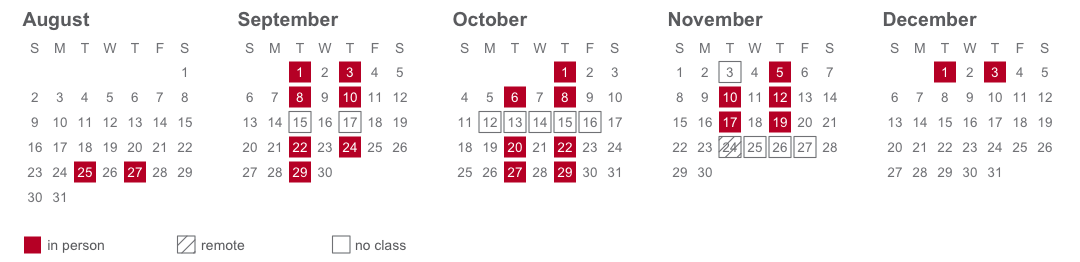
CMU Academic Calendar
TA: Zakareya Hamed
Email: zhamed@andrew.cmu.edu
Office Hours: arrange via email
Course Relevance: DC: Perspectives on Justice and Injustice
Learning Resources: All resources will be provided via Canvas
Prerequisite Knowledge: NONE

Course Description
Are Americans really so divided? The question sounds rhetorical, but political scientists have spent thirty years disagreeing about the answer, and the first month of this course works through that argument: whether the public has genuinely polarized or merely sorted itself into tidier parties, what people mean by “affective polarization” and whether it does the damage commonly attributed to it, how race and partisanship reinforce one another, and whether any of this actually threatens democracy. You will read scholars arguing with each other in print, sometimes over the same data.
The rest of the semester belongs to you. Working in teams of three, you will choose a topic, assign your classmates the readings, lay out the genuine controversies, and run the discussion yourselves. Alongside that you will write an op-ed for a general audience, review a book and present it to the class, and build a policy brief with a small team.
Running through all of it is a question about justice: how political division creates and entrenches inequality — who gets heard, who gets represented, and who absorbs the costs of a politics organized around mutual dislike. No previous coursework in political science is expected, and no statistics beyond reading a chart.
Learning Objectives
By the end of this course, students will be able to:
- Explain what political scientists have actually established about polarization in the United States, and identify where they still disagree.
- Distinguish ideological polarization, partisan sorting, affective polarization, and negative partisanship, and weigh the evidence offered for each.
- Analyze how political divisions intersect with and reinforce racial, economic, and social inequality.
- Evaluate competing arguments on contested questions — including the argument you disagree with, in its strongest form.
- Facilitate informed discussion: select readings, frame questions that have no easy answer, and moderate disagreement without flattening it.
- Communicate persuasively to a general audience, in writing and aloud.
- Develop evidence-based policy recommendations and account for their consequences for equity.
- Reflect on your own values, biases, and role as a civic participant in a divided society.
Grading
Your grade depends heavily on active engagement. This course is interactive: your preparation (completing the readings), contributions to discussions, and participation in debates are essential to your success.
Assignments & Deadlines You are expected to meet all assignment deadlines. If you anticipate being unable to turn something in on time, contact me before the due date to discuss alternatives. Late work will incur a penalty1 provided it does not impede your classmates’ progress (for instance, in group projects). Failing to participate or contribute meaningfully, especially in ways that affect others’ work, will result in a lower grade.
Assessment
The course grade will be a weighted average of the following components:
| Assignment | Percent of Final Grade |
|---|---|
| Attendance | 25% |
| Discussion Board (before each class) | 15% |
| Student Led Topics | 9% |
| Surveys (3: intake, midterm, evaluation) | 2% |
| Book Review (Slides + Presentation) | 12% |
| Op-Ed Project (Draft + Review + Final) | 20% |
| Group Policy Brief | 17% |
Due Dates
| Assignment | Due Date |
|---|---|
| Discussion board post | 9:00 a.m., each class day |
| Surveys (3) | August 26, October 7, final week |
| Op-ed, first draft | September 21 |
| Op-ed peer review | September 24 |
| Op-ed final draft | September 28 |
| Book Review (slides) | October 24 |
| Group Project | December 1/3 |
| Group Project reflection | December 4 |
Assignment Details
Attendance (25%)
Purpose: Civic discourse, empathy, critical thinking
Objective Alignment: 4, 8

Showing up is the assignment. This grade covers both being here and being present once you are — arriving prepared (having completed the readings) and contributing thoughtfully and respectfully to discussion.
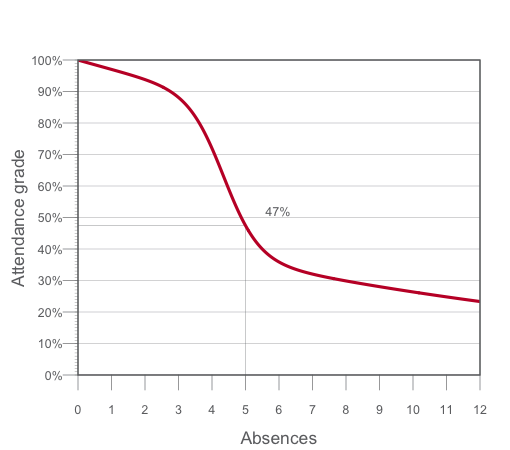
Regular attendance and active involvement form a significant part of your final grade (see grading section). If you do not show up, you will not earn an ‘A’. To recognize that occasional absences are sometimes unavoidable (e.g., for religious observance, job interviews, university-sanctioned events, or illness), attendance grades follow a curve with three stretches. The first three absences cost you almost nothing — that is what they are there for. From the fourth to the sixth the penalty bites hard, and this is the range where a semester goes wrong. After that the curve flattens into a long tail: each further absence still costs you, but less, and it never reaches zero. There is no point at which you may as well stop coming.
| Absences | 0 | 2 | 3 | 4 | 5 | 6 | 8 | 12 |
|---|---|---|---|---|---|---|---|---|
| Attendance grade | 100% | 94% | 88% | 72% | 47% | 36% | 30% | 23% |
If you must miss class, please notify the TA (and cc the professor) at least 24 hours in advance (unless it is an emergency or sudden illness) so we can arrange a way for you to catch up.2
Devices. Laptops, tablets, and phones are not to be used for anything that is not pertinent to what we are doing in the room. The simplest version of this: keep them in your bag. If you are found using a device for something unrelated to class, you will be marked absent for that session — see the curve above for what that costs.
This is not about distraction alone. This course runs on discussion, and a room where half the screens are open is a room where people are performing attention rather than paying it. You will also be asked, repeatedly, to sit with an argument you dislike before responding to it; a device is the easiest available exit from that discomfort, and taking the exit is how you learn nothing.
If you have an accommodation from the Office of Disability Resources that involves a device, it governs — bring me your letter and this policy does not apply to you.
Discussion Board (15%)
Purpose: Arriving with your thinking already underway
Objective Alignment: 1, 4, 8
Before every class meeting you post at least one comment to the course discussion board. Posts are due by 9:00 a.m. on the day we meet, which gives me time to read the room before I walk into it — and gives you a reason to have opened the reading before the hour it is discussed.
Either raise something or answer someone. A post counts if it does one of two things: it puts a question on the table, or it responds to a question or comment a classmate has already put there. Both are worth the same. A thread where nobody replies is just a stack of monologues, and a thread where nobody asks anything runs out of road — the board needs both, and you can supply either.
Keep it short. A few sentences is plenty; there is no length requirement and no credit for padding. What matters is that you have put something down before the conversation starts.
What to raise, or what to answer, depends on the day.
- When a student team is leading, that team posts its discussion questions to the board in advance. Your comment answers one of them. These are the days the board does the most work, because the leaders arrive already knowing where the room stands.
- When the day has an assigned reading, respond to it: what you found unconvincing, where two readings collide, a question they raise and do not answer.
- Otherwise, the floor is open. Post what is actually on your mind — something in the news, something from an earlier session you are still chewing on, a question you did not get to ask out loud. Not every class needs a set topic for you to have something worth saying.
Grading. Completion and engagement, not correctness. Every post is worth the same, and they simply add up: there are 21 across the semester, so each one is worth a little under five percent of the board grade. Miss one and you lose that much; miss five and you have lost about a quarter of it. Nothing is forgiven automatically and nothing accelerates — the arithmetic is the whole policy, and you can work out where you stand at any point in the term from your own record in Canvas.
Your two lowest scores are dropped, automatically and without your asking. A bad week, an illness, a day you simply forgot — two of those cost you nothing, and you never have to explain them to me. Past that, the arithmetic above applies.
Each post is marked complete or incomplete. A post that shows you engaged with the day is complete; there is no partial credit and no bonus for length.
Each board opens a week before its class and closes when we meet. You can work ahead if you like, but a board does not reopen once the conversation it was for has happened.
The board is visible to everyone in the class. That is the point; it lets a discussion open already in motion instead of from a standing start, and it means the quiet half of the room has said something before anyone speaks aloud. But be clear-eyed about what a board is. Unlike what we say aloud in this room, a post is written down, attached to your name, and takes one keystroke to capture. I cannot stop anyone from screenshotting it and I am not going to pretend otherwise. Write accordingly: say what you actually think, and assume it could travel.
Student Led Topics (9%)
Purpose: Facilitation, synthesis, reflection
Objective Alignment: 2, 4, 5, 6
You will run a class. Not present to one, run it.
Working in a team of three or four, you choose a topic connected to the course themes, assign the readings your classmates will do beforehand, and lead the session. Teams and topics are set on September 1, and the calendar of who leads which day is fixed that week and does not move.
What your team owes the class, one week before you lead:
- A topic. Narrow enough to argue about in eighty minutes. “Immigration” is not a topic; “whether birthright citizenship can be altered by executive order” is.
- The readings. Two or three pieces, and no more than about sixty pages total. They must not all argue the same side. Post them to Canvas a full week ahead so your classmates can actually read them. A reading posted late is a session that falls flat, and the whole class pays for it. Ideally, multiple points of view are reflected in the readings.
- Discussion questions. Five or six, written out, posted to the discussion board so the class answers them before you meet. Good ones have no obvious answer and cannot be resolved by looking something up.
- A statement of the controversies. A short written list of the genuine points of disagreement on your topic: what is actually contested, who holds each position, and what each side takes to be its strongest argument. This is the part that separates a real discussion from a book report.
On the day your team runs the room: open the question, keep the conversation moving, pull in people who have not spoken, and cut off a thread that has stopped going anywhere. I will be there and will step in if needed, but the session is yours.
Afterward, a short written reflection: what you took from the sessions your classmates led and from your own, what changed your thinking, what you would do differently.
A note on the readings: the strongest sessions in past years have not all been academic articles. A podcast episode, a documentary segment, an op-ed pair from opposing outlets, or a piece of data journalism can carry a discussion as well as a scholarly paper — often better. Vary the voices you assign.
Surveys (2%)
Purpose: Getting to know you, your goals, and what is working in the
course
Objective Alignment: 8
You will complete three short surveys: one in the first week, one at the midpoint of the semester, and one in the final week. The first uses the Cervas Election Study, a survey instrument modelled on the Cooperative Election Study; the midpoint survey is course feedback; the last is an end-of-course evaluation. Links are posted in Canvas, under Assignments. They serve four ends:
- Who is in the room. Your background, your experience with the material, and the perspectives you bring — so I can teach the class that is actually in front of me.
- How the course is going. Candid feedback on what is working and what is not, early enough in the semester that I can still act on it.
- What you want from the course. What drew you here and what you hope to get out of it, so the topics we spend time on reflect your interests.
- What you think other people are like. The first survey ends with eight questions asking you to estimate the composition of the two parties — how many Democrats are union members, how many Republicans earn over $250,000, and so on. Answer cold. Do not look anything up and do not confer: a wrong guess is useful and a correct look-up is worthless.
That last block is the one you will hear about again. Your answers become a class dataset, which I report back in aggregate — never individually, and never in a form that identifies anyone. We put it beside the published figures on September 8, when you read the study these questions come from, and find out how far off this room is — and whether it is off in the same direction as the country.
Graded purely for completion — there are no right answers, and nothing you say is graded on content. The estimates in particular are not graded on accuracy. Being wrong is the finding.
The survey itself is anonymous: it asks no name, requires no login, and records nothing that identifies you — which also means it cannot tell me you completed it. So credit works like this: after you submit, screenshot the confirmation screen and upload it to the Canvas assignment. The screenshot is your receipt; the survey data never learns who you are.
Book Review Assignment (12%)
Purpose: Deep analysis, critical evaluation, communication
Objective Alignment: 1, 2, 4, 6
- Slide Deck (5%)
Purpose: Argument analysis, assumption critique, implication discussion
-
Length: No fewer than 5 slides and no more than 10, excluding a title slide and any references slide.
-
Content Guidelines:
- Summarize the author’s central argument(s) succinctly.
- Critically evaluate those arguments using logical reasoning and textual evidence.
- Identify any assumptions or ideological lenses the author brings.
- Discuss broader political, ethical, or social implications.
- Make connections to course themes such as inequality, polarization, or justice.
- Cite anything you quote or paraphrase.
-
On slide design: a slide is not a page. Put one idea on each, in words large enough to read from the back of the room, and let the rest live in what you say. A deck of dense paragraphs read aloud is the failure mode this assignment is built to avoid. Ten sparse slides beat five crowded ones, and the ceiling is there to stop the deck from becoming the paper.
-
In-Class Oral Presentation (7%)
Purpose: Verbal synthesis, peer engagement, clarity of thought
Format: Short oral presentation to the class, followed by discussion
- Expectations:
- Clear, engaging summary of key ideas from the book.
- Highlight your critical take or most interesting insight.
- Open the floor by posing a question or provocation, and field your classmates’ responses.
- Speak to your slides rather than reading them; the presentation is assessed on delivery and engagement, not on narrating the deck.
Op-ed w/ peer-review (20%)
Purpose: Persuasive writing, revision, public engagement
Objective Alignment: 3, 6, 7
- Drawing on a topic related to this course, or something political from your own life or experience, write an op-ed that could be published in a newspaper or blog.
The weight sits where the work is. Writing the thing and reading someone else’s carefully are the hard parts; the final draft is where you carry out edits you have already been handed.
- Rough Draft (10%)
- Length: There is a strict 1,250-word limit.
- Content Guidelines:
- Prepare a short essay advocating for (or against) any social or political issue of your choosing.
- The idea is that you will write something that can be submitted to a newspaper or internet blog.
- Concise arguments made for a more general audience are the goal of this assignment; something your parents can read and understand.
- The use of data and visualizations is strongly encouraged and is not included in the word count.
- Graded as a finished piece, not as a sketch. Hand in something you would be willing to see published — a draft written to be fixed later is worth very little to the classmate who has to review it.
- This deadline is hard, and it is the one deadline in the course with no exceptions. A late draft costs 10% immediately, and a further 1% for every hour after that. Unlike everything else in this course, it can reach zero.
- The reason is not severity for its own sake. Two classmates are assigned to read you, and when review assignments go out, whatever exists is what they get. If your draft is not there, they are given someone else’s instead, the class is not held up waiting for you. But you go into your final draft without the feedback everyone else received, you still owe the two reviews you were assigned, and the points are gone. The cost of being late lands on you, which is exactly where it belongs.
- Peer Review (8%)
- You will review two classmates’ drafts. This is worth nearly as much as writing your own, and is graded on the quality of what you give them.
- Address the substance first, then the prose: Is the thesis clear, and is it stated early enough? Is the evidence convincing? Would a reader outside this class follow it? Where does it lose momentum?
- Say the useful thing. “Nice job” is not a review; naming the paragraph where the argument stops working is.
- Final Draft (2%)
- Carry out the revisions your reviewers identified, and improve anything else you now see. This is assessed on whether you took the feedback seriously — what changed, and why — rather than re-graded as a fresh piece of writing.
- If you disagree with a reviewer, you are free to leave it as it was; note briefly why, and that counts as taking it seriously.
Group Policy Brief (17%)
Purpose: Research, equity-centered solutions, teamwork Objective Alignment: 3, 7, 8
- Written Brief (10%): Small teams choose a politically polarizing
issue tied to inequality (e.g., gerrymandering, Medicaid expansion,
tech bias) and write a formal policy brief (~1,500–2,000 words).
- Components:
- Executive Summary
- Problem Definition
- Background/Context
- Policy Options & Stakeholder Analysis
- Recommendation(s)
- Equity Impact Statement
- Components:
- Presentation (5%): Teams present findings in a mock legislative or community forum during finals week.
- Individual Reflection (2%): A short piece, submitted on your own
after your team presents, on how the work actually went.
- Address:
- What you personally contributed — specific tasks, sections, and decisions, not “I helped with research.”
- What each teammate contributed, in the same concrete terms.
- How the team divided work, and whether that division held up.
- What you would do differently on a team project next time.
- Submitted individually and read only by the instructors. Your teammates never see it.
- These evaluations can move your grade. Where the reflections from a team agree that contribution was substantially uneven, I may adjust individual grades on the brief and the presentation above or below the team grade. A team that divided the work fairly sees no adjustment, which is the ordinary outcome.
- Be candid in both directions. Credit is easy to overlook, and a teammate who carried more than their share should be named. If the load was uneven, say so plainly — a group grade that lands identically on someone who did the work and someone who did not is its own kind of unfairness, and this is how I find out.
- Address:
Course Schedule
Week 1 — August 25 & 27
August 25
- Introduction to the Course; draft privacy/free speech statement
- Student-led sessions — nothing is settled today. Teams and topics are fixed on September 1, not now. Between then and now, look through the topic bank at the end of this syllabus and come to that session with two or three you would be willing to lead.
- Survey 1 — the Cervas Election Study. Take it on your own after class; it is due August 26 at 11:59 p.m. The link is in Canvas, under Assignments, and it runs about ten minutes. When the confirmation screen appears, screenshot it and upload it to the same Canvas assignment — that screenshot is what earns the credit, because the survey itself has no idea who you are.
- More in Common. The Perception Gap — https://perceptiongap.us/
- Take this after you have submitted the survey, not before. It runs a version of the same exercise on a national sample, so it tells you how the country does. The survey tells you how this room does, and the gap between those two is the more interesting number.
- The finding, briefly: partisans on both sides imagine roughly twice as many of their opponents hold extreme views as actually do. The part worth arguing about is what follows — people who follow politics closely, and who post about it, have wider perception gaps than people who do not. Which is to say the problem may not be that Americans know too little about each other, but that the sources telling them about each other are not describing anyone real.
- We come back to your own answers on September 8, alongside the study these questions are taken from, and again on September 10 with a political scientist who reads the same evidence as showing the polarization everyone worries about has been overstated.
August 27
The Fence
- Background on “The Fence”
- President Farnam’s Statement about the Fence after Trump Visit
- Articles from The Tartan about The Fence`s history
- Student Handbook, Advertising on Campus - Graffiti and Poster Policy of Student Government
- Student Government Graffiti and Poster Policy
Week 2 — September 1 & 3
September 1
Organize Topics for Student Led Discussions
Teams and topics are settled today, and the calendar of who leads which day is fixed in this session and does not move afterwards. Come with two or three topics you would be willing to lead. The bank at the end of this syllabus is a starting point rather than a menu — a topic of your own is welcome, and the readings you assign are yours to choose.
September 3
Polarization Research I — Partisan and Ideological Polarization
Is the public itself polarized, or only the people it elects? These two pieces are a direct exchange: Abramowitz and Saunders are answering Fiorina and Abrams by name. Read them as a model for what your own team’s session should do.
- Fiorina, Morris P., and Samuel J. Abrams. 2008. “Political Polarization in the American Public.” Annual Review of Political Science 11: 563–588.
- Abramowitz, Alan I., and Kyle L. Saunders. 2008. “Is Polarization a Myth?” The Journal of Politics 70(2): 542–555.
- Fiorina, Morris P. 2024. “Once More Unto the Breach: Is America Polarized?” Hoover Institution. — the same argument sixteen years on, written for a general audience. Free.
Optional
- Fiorina, Morris P. 2026. Unstable Majorities Continue: The Trump
Era. Hoover Institution Press. — Chapter 8, “The 2024 Election:
Party Performance and Party Policies” (23 pages). Chapters 1–6 of
this book are the essays assigned elsewhere in this unit, so skip
them. Chapters 7 and 8 are new: written after the election, they ask
whether 2024 changed the picture. Fiorina’s answer is that it did not.
Chapter 7, “The 2024 Election: Candidates and Campaigns” (15 pages),
covers the campaign itself if you want it.
- CMU catalog record — unlimited simultaneous access, so you never have to wait for a copy. Read it in the browser, or use “Download PDF Chapter” for a copy that does not expire.3
- McCarty, Nolan, Keith T. Poole, and Howard Rosenthal. Polarized America: The Dance of Ideology and Unequal Riches. MIT Press. — the elite side of the story, measured through congressional roll calls.
Week 3 — September 8 & 10
September 8
Polarization Research II — Sorting and Social Identity
How party stopped being a preference and became an identity — and what happens when we are badly wrong about who actually belongs to the other party.
- Mason, Lilliana. 2015. “‘I Disrespectfully Agree’: The Differential Effects of Partisan Sorting on Social and Issue Polarization.” American Journal of Political Science 59(1): 128–145.
- Ahler, Douglas J., and Gaurav Sood. 2018. “The Parties in Our Heads:
Misperceptions about Party Composition and Their Consequences.” The
Journal of Politics 80(3): 964–981.
- https://doi.org/10.1086/697253
- Respondents put 32% of Democrats in the LGBT category (actual: 6%) and 38% of Republicans above $250,000 a year (actual: 2%). Come to class with a guess of your own before you read the numbers.
Optional
- Mason, Lilliana. 2018. Uncivil Agreement: How Politics Became Our Identity. University of Chicago Press. — Chapters 1–2. Print only at Hunt Library (JK2271 .M312 2018); CMU has no online copy, so this one is for the curious rather than the whole class. The required Mason article above carries the same core argument.
September 10
Polarization Research III — Affective Polarization
Disliking the other side more than you like your own. Start with the survey piece, then read the two challenges — the finding is not as settled as the first two readings make it sound.
- Iyengar, Shanto, Yphtach Lelkes, Matthew Levendusky, Neil Malhotra, and Sean J. Westwood. 2019. “The Origins and Consequences of Affective Polarization in the United States.” Annual Review of Political Science 22: 129–146.
- Finkel, Eli J. et al. 2020. “Political Sectarianism in America.” Science 370(6516): 533–536. — four pages.
- Fiorina, Morris P. 2024. “What About Affective Polarization?” Hoover Institution. — sixteen pages, free, and an argument with the two readings above. Fiorina quotes Finkel’s “poisonous cocktail,” works through the Ahler and Sood misperception numbers you read for the last session, and contends the whole research program was “adopted more quickly and less critically than is scientifically justified.” Note whose data Figure 1 is built from.
Optional — the counterarguments
- Klar, Samara, Yanna Krupnikov, and John Barry Ryan. 2018. “Affective Polarization or Partisan Disdain? Untangling a Dislike for the Opposing Party from a Dislike of Partisanship.” Public Opinion Quarterly 82(2): 379–390.
- Broockman, David E., Joshua L. Kalla, and Sean J. Westwood. 2023. “Does Affective Polarization Undermine Democratic Norms or Accountability? Maybe Not.” American Journal of Political Science 67: 808–828. — five experiments arguing the causal arrow is weaker than assumed.
Week 4 — September 15 & 17
September 15
ERADICATE HATE CONFERENCE, no class
September 17
CONSTITUTION DAY SYMPOSIUM, no class
Week 5 — September 22 & 24
September 22
Polarization Research IV — Negative Partisanship and the White Working Class
Voting against rather than for. Note how much of the trend Abramowitz and Webster explain without anyone’s opinions on policy changing at all.
Then a live exchange: Fiorina and Abramowitz answering the same question about white working-class Republicanism eight months apart, in public, for free. Both are reading the same survey data. Work out where exactly they part company.
- Abramowitz, Alan I., and Steven W. Webster. 2016. “The Rise of Negative Partisanship and the Nationalization of U.S. Elections in the 21st Century.” Electoral Studies 41: 12–22.
- Iyengar, Shanto, and Sean J. Westwood. 2015. “Fear and Loathing across
Party Lines: New Evidence on Group Polarization.” American Journal of
Political Science 59(3): 690–707.
- https://doi.org/10.1111/ajps.12152
- The scholarship-award and trust-game experiments are the ones to focus on.
- Abramowitz, Alan I. 2025. “It’s Not the Economy, Stupid: The Ideological Foundations of White Working Class Republicanism.” Sabato’s Crystal Ball, April 3.
- Fiorina, Morris P. 2024. “The White Working Class.” Hoover Institution.
Optional
- Fiorina, Morris P. 2024. “Economic Anxiety or Cultural Backlash: Which Is Key to Trump’s Support?” Hoover Institution.
- Abramowitz, Alan I., and Steven W. Webster. 2018. “Negative Partisanship: Why Americans Dislike Parties But Behave Like Rabid Partisans.” Political Psychology 39: 119–135.
September 24
Polarization Research V — Race and Polarization
- Tesler, Michael. 2012. “The Spillover of Racialization into Health Care: How President Obama Polarized Public Opinion by Racial Attitudes and Race.” American Journal of Political Science 56(3): 690–704.
- Mason, Lilliana, Julie Wronski, and John V. Kane. 2021. “Activating Animus: The Uniquely Social Roots of Trump Support.” American Political Science Review 115(4): 1508–1516.
Optional
- Jardina, Ashley. 2019. White Identity Politics. Cambridge University Press. — Chapter 1. Available online through the CMU Library, so read it there rather than buying it.
Looking ahead — worth reading before your team leads, whatever your topic:
- Voelkel, Jan G. et al. 2024. “Megastudy Testing 25 Treatments to Reduce Antidemocratic Attitudes and Partisan Animosity.” Science. — 32,059 participants. Reducing partisan animosity did not reliably reduce support for undemocratic practices; the two move separately.
- Kleinfeld, Rachel. 2023. Polarization, Democracy, and Political Violence in the United States: What the Research Says. Carnegie Endowment for International Peace.
Week 6 — September 29 & October 1
September 29
Polarization Research VI — Does Any of This Threaten Democracy?
The claim that polarization endangers democracy is the one everybody repeats and almost nobody examines. Two teams of scholars look at overlapping evidence and reach opposite conclusions; a third pair stops asking what Americans believe and puts a price on it instead. This is the last session before your own turns begin, so treat it as the model: credible sources, a real disagreement, and a question that the readings do not settle for you.
- Druckman, James N., Donald P. Green, and Shanto Iyengar. 2023. “Does Affective Polarization Contribute to Democratic Backsliding in America?” The ANNALS of the American Academy of Political and Social Science 708(1): 137–163. — scant evidence of a direct link.
- McCoy, Jennifer, and Murat Somer. 2019. “Toward a Theory of Pernicious Polarization and How It Harms Democracies: Comparative Evidence and Possible Remedies.” The ANNALS of the American Academy of Political and Social Science 681(1): 234–271. — it does, and here is the mechanism.
Then the price.
Everyone says they support democracy. More than 85% of Americans tell surveys that democracy beats any alternative, and that number has barely moved in sixty years. Graham and Svolik think the question is close to worthless, because saying you value democracy costs nothing and voting against your own side costs something. So they stop asking and instead put a price on it: what will Americans actually give up to punish a politician who breaks the rules? The answer, in a realistic general election, is about 3.5% of the vote — which is to say, in most districts, nothing that would cost anyone their seat.
Read the plain-language version. It is written for this course, has no equations in it, and takes about fifteen minutes. Read the original if you want to see where the numbers come from; the guide ends with a table telling you which page each one is on.
- Start here: Would You Vote Against Your Own Side to Save
Democracy?
— a plain-language guide to the article below.
- Do the two-matchup exercise at the end before class, and write down both answers. The gap between them is the finding.
- Graham, Matthew H., and Milan W. Svolik. 2020. “Democracy in America?
Partisanship, Polarization, and the Robustness of Support for
Democracy in the United States.” American Political Science Review
114(2): 392–409.
- https://doi.org/10.1017/S0003055420000052 — open access.
This is the sharpest statement of the claim the last third of the course argues about: that polarization is dangerous not because Americans stop believing in democracy, but because it makes believing in it cheap and acting on it expensive. We pick it up again on November 5, two days after the midterms, when the question is no longer hypothetical.
Both ANNALS articles sit in special issues that make good hunting grounds for your own session — volume 708 on threats to American democracy, volume 681 on polarization worldwide. The library has the ANNALS online.
October 1
Polarization Research VII — Geographic Polarization: The Map and What It Doesn’t Show
You have seen the county map. Almost nobody is asked what it actually shows. This session is about three questions that students routinely collapse into one, and that the field answers differently.
Are we more geographically sorted than we used to be? Mostly yes, and the answer got much firmer once researchers stopped using counties and started using voter files. Is it because people are moving to be near their own kind? Almost certainly not — that turns out to explain about an eighth of it. And is the divide still widening? As of 2026, honestly, nobody knows. The two best sources on the 2024 election disagree with each other.
Read the short pieces first. Do the two map exercises before class; they take ten minutes together and they are the point.
Do these before you read anything.
- Brown, Jacob R., and Ryan D. Enos. “Partisan Segregation.” Interactive
maps.
- https://www.ryandenos.com/partisan-segregation
- Built from the exact residential location of every registered voter in the country. Find your home metro and your hometown’s congressional district. Write down where they rank.
- The New York Times. 2025. “An Extremely Detailed Map of the 2024
Election Results.”
- https://www.nytimes.com/interactive/2025/us/elections/2024-election-map-precinct-results.html
- Search your own address. Most of you live somewhere considerably less politically mixed than you assume. Bring your precinct’s margin to class.
- Metered paywall — I will post a gift link. Free precinct shapefiles: https://github.com/nytimes/presidential-precinct-map-2024
Then read these.
- Brown, Jacob R., Enrico Cantoni, Ryan D. Enos, Vincent Pons, and
Emilie Sartre. 2026. “How Generational Turnover and Party Switching
Reshape the US Political Map.” CEPR/VoxEU, March 9. — five pages,
free, and the single most important finding in this literature.
- https://cepr.org/voxeu/columns/how-generational-turnover-and-party-switching-reshape-us-political-map
- Every registered voter in 29 states plus D.C., 2008–2020 — about 143 million people. Segregation rose at every geographic level, down to the census block. Then they decompose why, and the answer is not what anyone expects: moving accounts for 12–14% of the change. Generational turnover does most of the work in Democratic-trending counties (47%); party switching — people re-registering without moving an inch — does most of it in Republican-trending ones (40%).
- The underlying paper is Brown, Cantoni, Enos, Pons and Sartre, “Sources and Extent of Rising Partisan Segregation in the U.S.,” NBER Working Paper 33422 (2025, revised 2026), free at https://www.nber.org/papers/w33422. It is under review, not yet published — cite it as a working paper.
- Abrams, Samuel J., and Morris P. Fiorina. 2012. “‘The Big Sort’ That
Wasn’t: A Skeptical Reexamination.” PS: Political Science & Politics
45(2): 203–210. — eight pages.
- https://doi.org/10.1017/S1049096512000017
- Fiorina again, doing to political geography what he does to everything else in this course. His target is Bill Bishop’s bestselling The Big Sort (2008) and its “landslide county” metric: counties are enormous and internally mixed, so a county-level statistic tells you almost nothing about whether neighborhoods have changed. Worth asking as you read the piece above: does the voter-file evidence answer Fiorina, or did he just pick the wrong unit to be skeptical about?
- “How the Other Half Votes: The Big Counties Versus the Rest of the
Country in 2024.” Sabato’s Crystal Ball, University of Virginia
Center for Politics. — fifteen minutes, free.
- https://centerforpolitics.org/crystalball/how-the-other-half-votes-the-big-counties-versus-the-rest-of-the-country-in-2024/
- About 151 of the country’s 3,100-plus counties cast half of all presidential votes. In 2024 that dense half went to Harris by 17 — but moved 7 points toward Trump, while the sparse half moved only 4. The gap between them narrowed for the first time since 2012, and it is still 36 points.
Come to class ready to answer this. If people are barely moving for politics, and in 2024 the densest places moved right faster than the sparsest ones, in what sense is America “sorting”? Two of you will be asked to argue that the sorting story is still basically right, and two to argue it has quietly stopped being true. You will not know in advance which.
Optional — for anyone who wants the fuller picture
- Brown, Jacob R., and Delfina Ferro. 2026. “Partisan Sorting and Geographic Polarization: How People and Politics Cluster by Place.” Forthcoming handbook chapter. — 42 pages, free, and the best current review. Organizes the field by scale: macro (region), meso (urban–rural), micro (neighborhood). Its framing line is the whole debate in one sentence — popular accounts simultaneously overstate and understate how segregated we are, which is why the literature looks like it contradicts itself.
- Brown, Jacob R., and Ryan D. Enos. 2021. “The Measurement of Partisan Sorting for 180 Million Voters.” Nature Human Behaviour 5(8): 998–1008. — the paper behind the maps you looked at. Instead of counties, it asks who your 1,000 nearest neighbors are. Ten percent of Democrats live somewhere with essentially no Republicans nearby.
- Mummolo, Jonathan, and Clayton Nall. 2017. “Why Partisans Do Not Sort: The Constraints on Political Segregation.” The Journal of Politics 79(1): 45–59. — Americans say they want politically congenial neighbors, then move for commute times and school districts. Note that this is the same move Graham and Svolik make with democracy: attach a real price to a stated preference and watch it evaporate.
- Brown, Jacob R. 2025. “Partisan Conversion Through Neighborhood Influence: How Voters Adopt the Partisanship of Their Neighbors.” The Journal of Politics 87(4): 1482–1498. — the mechanism that makes the map change without anyone moving. Panel of 41 million voters.
- Scala, Dante J., and Kenneth M. Johnson. 2017. “Political Polarization along the Rural-Urban Continuum? The Geography of the Presidential Vote, 2000–2016.” The ANNALS of the American Academy of Political and Social Science 672(1): 162–184. — the divide is a smooth gradient, not a city-limits line, and the sharpest political break sits out past the edge of the suburbs.
* Chapter 2: [Why Is Free Speech Important?](https://canvas.cmu.edu/courses/47827/files/folder/Free%20Speech%20on%20Campus?preview=13149839) <!-- TODO: F26 Canvas course ID -->
The History of Academic Freedom
- Chemerinsky, Erwin, and Howard Gillman. 2018. Free speech on campus.
Paperback edition. New Haven; London: Yale University Press.
- Chapter 3: Nullius in Verba: Free Speech at Colleges and Universities
- Chapter 4: Hate Speech
- Chapter 5: What Campuses Can and Can’t Do
- Chapter 6: What’s at Stake? (short)
Racism in Policing
Racism in Policing
- Bangs, R. “Pittsburgh’s Massive Racial Disparities in Police Actions, 2021-2023” July 1, 2024.
- Bangs, R. “Police Discrimination Against Black Youth Under Age 18” October 1, 2024.
Optional: - Bangs, R. “Fourth Amendment Problems with Pittsburgh Police Policies” February 2025 * https://www.crsp.pitt.edu/fourth-amendment-problems-pittsburgh-police-policies - Bangs, R. “Pittsburgh Leaders Must Recognize the Serious Racial Problems in Police Actions” January 2025 * https://live-racesocialproblems-pitt.pantheonsite.io/pittsburgh-leaders-must-recognize-serious-racial-problems-police-actions - Bangs, R. “Racial Disparities and Discrimination in Drug Arrest Charges by Pittsburgh Police, January-October 2022” November 2024 * https://www.crsp.pitt.edu/racial-disparities-and-discrimination-drug-arrest-charges-pittsburgh-police-january-october-2022 - Bangs, R. “New National Reports on Anti-Black Pretextual Traffic Stops and Frisks, Related Pittsburgh Police Data, and Recommendations” October 15, 2024 * https://www.crsp.pitt.edu/new-national-reports-anti-black-pretextual-traffic-stops-and-frisks-related-pittsburgh-police-data
Ezra Klein, Why We’re Polarized
- Klein, Ezra. 2020. Why We’re Polarized. Avid Reader Press / Simon & Schuster. Available from CMU Library, and used at many bookstores. Working on making it available on Canvas.
- Klein, Introduction: What Didn’t Happen
- Klein, Chapter 1: How Democrats Became Liberals and Republicans Became Conservatives
- Klein, Chapter 2: The Dixiecrat Dilemma
- Klein, Chapter 3: Your Brain on Groups
- Klein, Chapter 4: The Press Secretary in Your Mind
- Klein, Chapter 5: Demographic Threat
- Klein, Chapter 6: The Media Divide beyond Left-Right
- Klein, Chapter 7: Post-Persuasion Elections
- Klein, Chapter 8: When Bipartisanship Becomes Irrational
- Klein, Chapter 9: The Difference between Democrats and Republicans
- Klein, Chapter 10: Managing Polarization—and Ourselves
The Internet and Social Media
- Larreguy, Horacio, and Pia J. Raffler. 2025. “Accountability in Developing Democracies: The Impact of the Internet, Social Media, and Polarization.” Annual Review of Political Science 28(Volume 28, 2025): 413–434.
- Barrett, Paul, Justin Hendrix, and Grant Sims. 2021. Fueling the Fire: How Social Media Intensifies U.S. Political Polarization And What Can Be Done About It. NYU Stern Center for Business and Human Rights.
- Shapiro, Ari. 2022. “How the polarizing effect of social media is speeding up.” NPR.
Identity Politics and Polarization
- Iyengar, Shanto. 2025. “Identity Politics, Party Polarization, and the Rise of Donald Trump.” In The Changing Character of the American Right, Volume I: Ideology, Politics and Policy in the Era of Trump, eds. Joel D. Aberbach et al. Cham: Springer Nature Switzerland, p. 79–94.
Academic Freedom (Rabban)
Academic Freedom
- Rabban, David M. “Academic Freedom”
- Introduction: https://canvas.cmu.edu/courses/47827/files/folder/Academic%20Freedom?preview=13401305
- Chapter 11 - Student Academic Freedom: https://canvas.cmu.edu/courses/47827/files/folder/Academic%20Freedom?preview=13401306
Potential topics for Student Led Discussions
- “Democracy” and “America” are not the same word. When people say polarization threatens democracy, some mean the procedures — elections, courts, the peaceful transfer — and some mean the country, its identity and who counts as a real American. The two arguments are often run together and they have different evidence behind them. Pulling them apart is a session on its own, and it bears directly on September 29.
Topic banks assembled in previous semesters. Students leading a session are welcome to draw on these, or to propose readings of their own.
Immigration Politics
- https://www.whitehouse.gov/presidential-actions/2025/01/protecting-the-american-people-against-invasion/
- https://www.cfr.org/backgrounder/us-immigration-debate-0
- Politico: Former ICE Director Q&A
- Reason: Immigration and Freedom
- Optional: RSF Journal: Immigration Study (PDF)
Affirmative Action (STUDENTS FOR FAIR ADMISSIONS, INC. v. PRESIDENT AND FELLOWS OF HARVARD COLLEGE, No. 20–1199)) - Decided June 29, 2023
- Opinion of the Court
- ROBERTS, C. J., delivered the opinion of the Court, in which THOMAS, ALITO, GORSUCH, KAVANAUGH, and BARRETT, JJ., joined.
- Dissent
- SOTOMAYOR, J., filed a dissenting opinion, in which KAGAN, J., joined, and in which JACKSON, J., joined as it applies to No. 21–707.
- Concurring & other Dissenting Opinions
- THOMAS, J., filed a concurring opinion.
- GORSUCH, J., filed a concurring opinion, in which THOMAS, J., joined.
- KAVANAUGH, J., filed a concurring opinion.
- JACKSON, J., filed a dissenting opinion in No. 21–707, in which SOTOMAYOR and KAGAN, JJ., joined.
- Background and commentary
- History of Affirmative Action
- Pew Research: Topic — Affirmative Action in College Admissions (Neutral Background)
- The Strange Career of Affirmative Action — Harvard Scholars
- Affirmative Action Article (Pro)
- Penn Carey Law: The Case for Affirmative Action (Pro)
- NAACP: Affirmative Action in Education Matters (Pro)
- Harvard GSE: The Case for Affirmative Action (Pro Case)
- Affirmative Action Was Wrong from the Start (Anti)
- Stanford Magazine: The Case Against Affirmative Action (Anti Case)
Gun Control
- Firearm Legislation and Firearm-Related Fatalities
- Ch17 — Liberty, Justice for Hedgehogs
- NRA-ILA | Why Gun Control Doesn’t Work
- U.S. Gun Policy: Global Comparisons | Council on Foreign Relations
- Do Studies Show Gun Control Works? No. - Reason.com
- For Most U.S. Gun Owners, Protection Is the Main Reason They Own a Gun | Pew Research
Voting Rights and Gerrymandering
- Required
- Optional
Reproductive Rights
- Andrea Tone, “Roe v. Wade (1973),” from Controlling Reproduction: An American History (1997), pp. 190–197.
- Excerpts from Dobbs v. Jackson Women’s Health Organization (2022)
- NPR, “Abortion wasn’t always the politically charged issue it is today” (2022)
- Throughline, “The Evangelical Vote” (2019)
- Diane Jackson and Jennifer Hoewe, “Congressional Discussions of Abortion: Moral Framing in Context.” In Partisan Rhetoric and Polarization: The Year in C-SPAN Archives Research, Volume 10, edited by Robert X. Browning, vol. 10, Purdue University Press, 2025, pp. 89–104. JSTOR.
- The New York Times, “Tracking Abortion Bans Across the Country” (updated continuously)
Birthright Citizenship
Regulating AI
Student Privacy in Class Discussions
Draft only — we write the real one together on the first day.
What follows is where a previous section of this course landed, reproduced here as a starting point and nothing more. On August 25 we will write our own, and whatever the class agrees to that day replaces everything below. Come ready to argue with it: the parts that look obviously right are usually the ones worth testing, and an agreement you had a hand in writing is one you might actually keep.
What this agreement is for
A discussion course works only if people will say what they actually think, and people say what they think only when they know what happens to their words afterward. That is what this agreement settles: what is on the record, what stays in the room, what may be repeated outside it and in what form. It exists to make candour possible, not to police it — which is also why you should be the ones to write it.
Shared Community Agreement (draft)
To foster a respectful and productive learning environment, the following policies apply:
No Recording of Class Discussions - Audio or video recording of class discussion is not permitted.
- Recording of lectures may be allowed with approval from Disability Resources.
Technology Use
- Laptops must remain closed.
- Phones must be put away unless otherwise specified.
Anonymity in Submissions
- All written work should be anonymized (no names on papers or submissions).
- Peer reviews will also remain anonymous.
Confidentiality of Classroom Contributions
- When discussing ideas from class outside of this setting, you may
reference the content
but not the identities of the individuals who contributed.
Respectful Dialogue - Listen attentively and allow peers to finish their thoughts before responding.
- Do not talk over one another.
- Treat others with the same respect you would expect for yourself.
Civility in Communication - Speak at a moderate volume.
- Critique ideas, not individuals.
- Assume the most generous interpretation of your peers’ statements.
Use of Generative AI (GAI)
- You may not use a peer’s work in generative AI tools without their explicit permission.
- Consider each peer’s work as copyrighted.
Representation of Opinions
- A peer’s views expressed in class do not represent the official
position of their
clubs, organizations, or extracurricular affiliations.
Course Principles
Four commitments run through the semester. They are not decoration — they are how the discussions are meant to work.
-
Establish the fact before arguing about the cause. Much of what everyone knows about American division turns out to be contested, mismeasured, or wrong, including by people who study it for a living. Before asking why Americans are divided we ask whether they are, how anyone would know, and what the evidence actually shows. You will read scholars disagreeing with each other over the same data, in print, by name.
-
Division and inequality are one subject, not two. Political conflict is not evenly costly. It shapes who is heard, who is represented, whose problems reach an agenda at all, and who absorbs the consequences of a politics organized around mutual dislike. Asking who bears those costs is the question of justice this course exists to raise, and it is not separable from the empirical work — you cannot answer it without knowing what is actually true about the divide.
-
Institutions decide who counts. Rules about voting, districting, representation, and speech are not neutral machinery. They distribute power, they were built by people with interests, and they can be built differently. We look at how the present arrangements came about and whom they serve.
-
Argue with the strongest version. You will be asked, repeatedly, to state a position you reject in terms its most serious advocate would recognize — and only then to disagree with it. This is harder than it sounds, and it is the central skill of the course. A semester spent defeating weak versions of other people’s views teaches nothing at all.
By the end of this course you should be able to state what people you disagree with actually believe, in terms they would accept, and to state what you believe with reasons that survive contact with someone who does not.
AI Use Policy for Student Work
The rule is short: the argument has to be yours. Use these tools to help you work; do not use them to do the work.
Reasonable use. Brainstorming. Generating the best counter-argument to your own position so you can answer it. Checking grammar and clarity. Asking for an explanation of something in a reading you did not follow. Asking where a draft of yours is unclear.
Not reasonable. Submitting generated prose or slides as your own. Producing your discussion-board posts. Having a tool write your peer review — that one takes something from a classmate who is owed a real reader. Turning in an argument you could not defend if asked about it here, in this room, out loud.
That last test is the one that matters, and it is specific to this course. Nearly everything you write here you may be asked to say aloud: your board post seeds a discussion, your slides come with a presentation, your op-ed and your brief are positions you have taken in front of people who can question them. If you cannot say why your argument makes the move it makes, how the text got produced is beside the point. You do not have the thing the assignment was for.
Say what you used. A line at the end of the op-ed or the brief, a final slide on the book review deck, a clause in a post: I used [tool] to [purpose]. That is the whole requirement. Disclosure costs you nothing and is never itself a problem. Undisclosed use is.
Do not put a classmate’s work into these tools without their explicit permission. Their draft is theirs, and they gave it to you to read, not to feed to something else.
Submitting generated work as your own is a violation of the university’s academic integrity policy and will be handled as one. If you are unsure whether something falls inside these lines, ask me before you submit rather than after.
Representation Statement
I am committed to including a broad range of perspectives in the readings and materials for this course. If you believe a critical voice is missing, please let me know so I can improve the syllabus now and in future offerings.
We must treat every individual with respect. We come from many different backgrounds, and this variety of viewpoints is fundamental to building and maintaining an equitable and inclusive campus community. “Representation” can refer to the ways we identify ourselves—race, color, national origin, language, sex, disability, age, sexual orientation, gender identity, religion, creed, ancestry, belief, veteran status, or genetic information, among others. Each of these identities shapes the perspectives our students, faculty, and staff bring to campus. Promoting these varied viewpoints not only fuels excellence and innovation but also advances the pursuit of justice. We acknowledge our imperfections while fully committing to the work—inside and outside our classrooms—of building and sustaining a campus community that embraces these core values.
Each of us is responsible for creating a safer, more inclusive environment.
Unfortunately, incidents of bias or discrimination do occur, whether intentional or unintentional. They contribute to an unwelcoming atmosphere for individuals and groups at the university. Therefore, the university encourages anyone who experiences or observes unfair or hostile treatment on the basis of identity to speak out for justice and seek support—either in the moment or afterward. You can share your experiences using the following resources:
- Ethics Reporting Hotline
Submit an anonymous report by calling 844-587-0793 or visiting cmu.ethicspoint.com.
All reports are documented and reviewed to determine whether further action is needed. Regardless of the incident type, the university will use your feedback to transform our campus climate into one that is more equitable and just.
Accommodations for Students with Disabilities
If you have a documented disability and an accommodations letter from the Office of Disability Resources, please discuss your needs with me as early in the semester as possible. I will work with you to ensure that accommodations are provided as appropriate. If you suspect you may have a disability and are not yet registered with the Office of Disability Resources, you can contact them at access@andrew.cmu.edu.
Student Well-Being
The past few years have been challenging. We are all under significant stress and uncertainty. I encourage you to find ways to move regularly, eat well, and reach out to your support system—or to me at cervas@cmu.edu—if you need help. We can all benefit from support during stressful times, and this semester is no exception.
As a student, you may experience a range of challenges that interfere with learning, such as strained relationships, increased anxiety, substance use, feeling down, difficulty concentrating, or lack of motivation. These mental health concerns or stressful events can diminish your academic performance and reduce your ability to participate in daily activities. CMU offers services that can help, and treatment does work. Learn more about confidential mental health services available on campus at:
- Counseling and Psychological Services:
http://www.cmu.edu/counseling/
Phone (24/7): 412-268-2922
Please remember that support is always available—don’t hesitate to reach out.
-
One percentage point per hour late, never falling below 50%. An hour or two costs almost nothing; a day costs a letter grade, but late work is always worth more than no work. Work never submitted scores zero, so handing something in a week late is always worth more than handing in nothing. Canvas applies both automatically. ↩
-
If you need to miss more than two sessions due to extenuating circumstances, let me know as soon as possible so we can discuss how best to support you. ↩
-
The per-chapter PDF allowance is capped at 77 pages for the whole book, so spend it on the chapters you actually want. “Download Book” is a different thing — it needs Adobe Digital Editions and expires. ↩